What's covered
A standard Arizona homeowners policy (HO-3) covers sudden, accidental, direct physical damage to the roof from a named or 'open' peril: wind, hail, lightning, a falling object, the weight of debris. In the West Valley that means the microburst that lifted your ridge tiles, the hail that cracked the west slope, the palo verde limb through the deck. It excludes wear and tear, deterioration, neglect, faulty workmanship and — this is the one that matters here — a roof that simply reached the end of its life. Felt underlayment that baked out over 22 years is not a claim. Thirty tiles cracked by half-dollar hail on August 9, 2026 is.
What the carrier pays
- RCV or ACV. Replacement cost value pays what it costs to repair or replace the damaged portion with like kind, minus your deductible, with depreciation often held back until the work is done. Actual cash value pays replacement cost minus depreciation — and many Arizona carriers now put roofs over 15 or 20 years old on ACV schedules, sometimes without the owner noticing. Check your declarations page.
- The deductible. Increasingly a separate wind/hail deductible of 1% or 2% of the dwelling coverage — $4,000 to $8,000 on a $400,000 house — rather than a flat $1,000 or $2,500.
- No matching. Arizona has no matching statute; the insurer owes the damaged portion, not a whole roof to make the new tile match the old (Trudel v. American Family, 2014). Whether a partial repair is acceptable is argued case by case.
- Mitigation. Emergency tarping and dry-in after a covered loss is covered — the policy requires you to prevent further damage.
What the carrier owes you, and when
Under Arizona's unfair-claim-settlement rules (A.A.C. R20-6-801) the carrier must acknowledge your claim within 10 working days, complete its investigation within 30 days of notice, and accept or deny within 15 working days of receiving your proof of loss. If it needs more time it has to tell you why, in writing. The Department of Insurance and Financial Institutions takes complaints at (602) 364-2499 or (800) 544-0708.
What Arizona forbids a roofer from doing
A.R.S. 32-1158.02 governs every contract for repair of storm damage that's the subject of an insurance claim. A contractor may not: advertise or promise to pay, waive, rebate or absorb any part of your deductible; act as your adjuster or negotiate your claim; take a down payment over 50%; or hold you to a contract you cancel within four business days of signing (for any reason) or within 72 hours of written notice that the claim was denied. Deposits must be refunded within 10 days of cancellation. The required notices appear in 10-point bold type on the contract. Only a licensed public adjuster may negotiate on your behalf (A.R.S. 20-321), and violations are grounds for ROC discipline. If a roofer offers to 'eat' your deductible, that is the whole conversation you need about that roofer.
The order of operations
- Document before you file. Dated photos, a count of cracked and lifted tiles, hail hits on shingles mapped in test squares, collateral damage on AC fins, gutters and screens, and a storm report tying it to a date for your address. We do this for free.
- Mitigate. Tarp or dry in anything that's actively leaking, and keep the invoice — it's covered.
- Decide whether it's worth filing. A $400 repair under a $4,000 wind/hail deductible isn't a claim. We'll tell you honestly.
- File with your carrier, yourself. Give them the date of loss and the documentation.
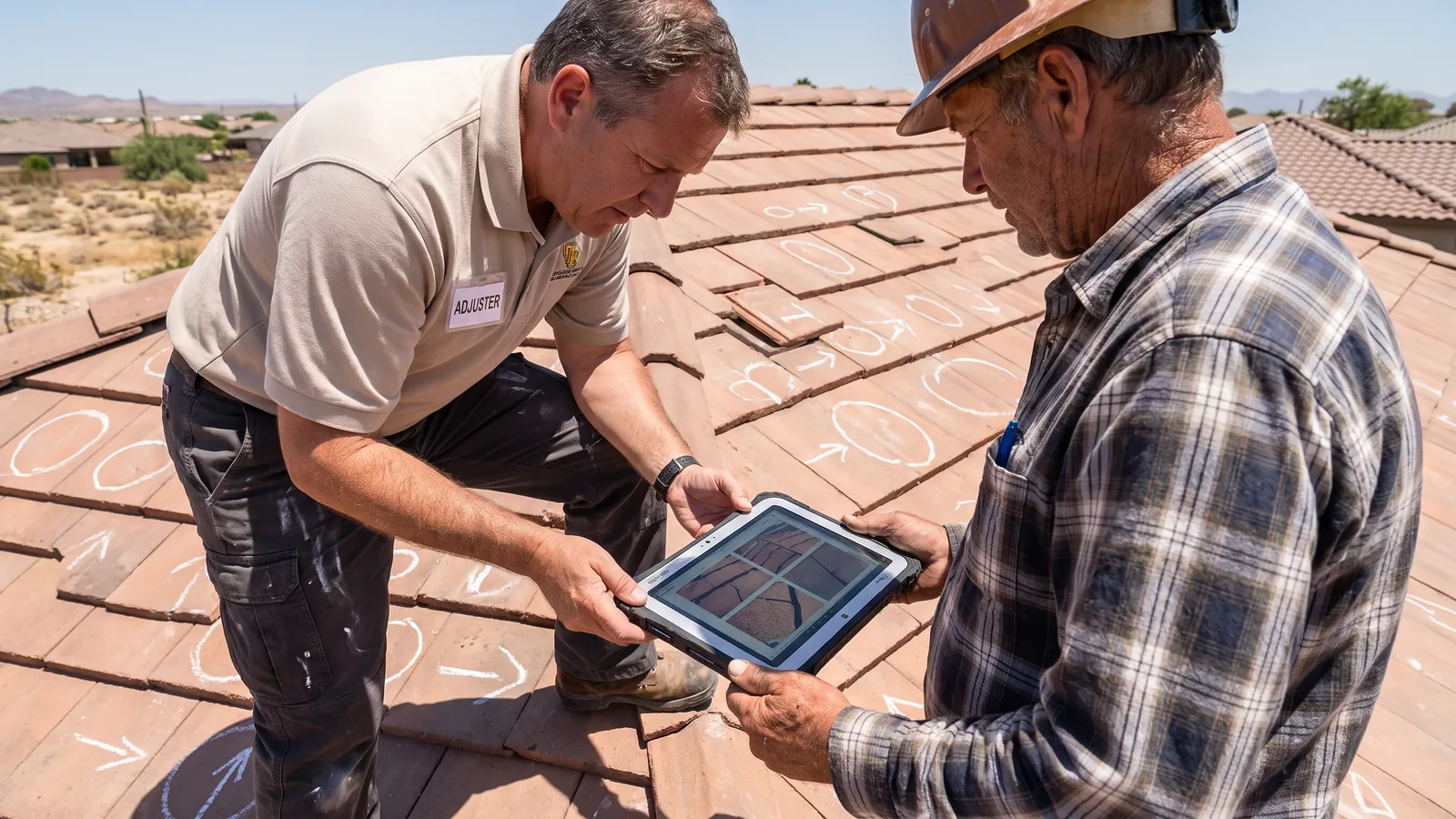
- Meet the adjuster with us on the roof. We walk the same tiles, show the same photos, and answer technical questions. We don't negotiate.
- Review the scope. If the adjuster's estimate missed damage, we document it and you submit a supplement.
- Build to the approved scope. You pay your deductible; the carrier pays the rest, with depreciation released on completion if you're on RCV.
Common questions
Should I call my insurance company or a roofer first?
A roofer — for the inspection and the documentation. Filing a claim is a record on your policy whether or not it pays, so it's worth knowing first whether the damage clears your deductible. Then you file, yourself, with photos in hand.
My roof is 24 years old. Will they cover storm damage?
Storm damage, yes; the age of the roof affects how they pay (ACV vs. RCV) and how hard the adjuster looks for 'wear.' Documentation that separates the cracked-by-hail tiles from the baked-out felt is what gets an old roof's storm claim approved.
Can the roofer bill my insurer directly?
Some do under an assignment of benefits. We don't take assignments and we don't bill carriers; you remain the policyholder and the customer, and the carrier pays you.
What's a public adjuster?
A state-licensed professional you can hire to negotiate your claim for a percentage of the payout. On a large or disputed claim it can be worth it. A roofer cannot legally do this job in Arizona.
The adjuster approved less than the roofer quoted. Now what?
Compare line by line. If the adjuster missed damage, we document it and you submit a supplement. If the carrier is simply paying less per unit than our price, that's a conversation about scope — we build what's approved and don't pad the invoice to close the gap.
Related: Roof insurance claims · Monsoon and hail damage · Insurance and financing · How to check an Arizona roofer